If you've tried to replace a dehumidifier purchased before 2020, you've likely been confused by the numbers. Your old "70-pint" unit is gone from store shelves. The biggest units now say 50 or 60 pints. Did manufacturers just start making smaller units?
No. The Department of Energy changed the test conditions in 2019, and all the numbers on the labels shifted. Here's a clear explanation of what changed, why it happened, and what it means for buying a replacement unit.
What the Old Standard Said
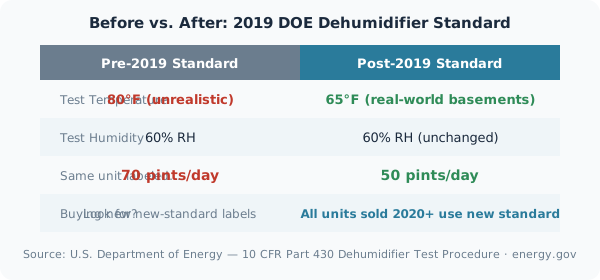
Before 2019, dehumidifiers were tested under AHAM HLD-1 conditions: 80°F air temperature and 60% relative humidity. These were the DOE's reference conditions for measuring moisture removal capacity.
The problem: 80°F is much warmer than a typical basement in summer. Most basements run at 60–70°F even in hot weather because they're below grade and thermally massive. At 80°F, warm air holds more moisture and the refrigerant coils work more efficiently, making units appear to remove more moisture per hour than they actually do in real homes.
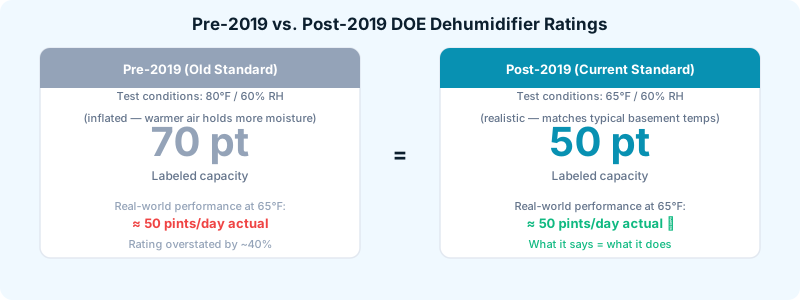
This led to inflated ratings that didn't reflect real-world basement performance. A "70-pint" dehumidifier tested at 80°F might only remove 48–52 pints per day in a 65°F basement, a significant shortfall that left homeowners with undersized units thinking they'd bought sufficient capacity.
What the 2019 DOE Rule Changed
The DOE's 2019 rule (effective June 13, 2019 for newly manufactured units) updated the standard test conditions to:
- 65°F air temperature (down from 80°F)
- 60% relative humidity (unchanged)
These conditions better represent actual basement environments where most residential dehumidifiers operate. The lower temperature means the refrigerant system works less efficiently per hour, removing less moisture, which produces lower (but more accurate) capacity ratings.
The DOE also updated efficiency requirements. The new standard required dehumidifiers to meet minimum Integrated Energy Factor (IEF) thresholds, measured in liters of water removed per kWh consumed. The efficiency floor was set higher for each size class, pushing manufacturers to improve compressor and refrigerant designs.
How Much Did Ratings Change?
The capacity drop was roughly 25–30% across all size classes. Some specific before-and-after comparisons for the same physical units:
| Old Rating (80°F/60% RH) | New Rating (65°F/60% RH) |
|---|---|
| 25 pints | ~18–20 pints |
| 30 pints | ~22–24 pints |
| 50 pints | ~35–38 pints |
| 70 pints | ~50–52 pints |
This is why the largest portable dehumidifiers on shelves today are labeled 50–70 pints, while the largest pre-2019 units were labeled 70–90 pints. The actual moisture-removal hardware is similar; the test methodology changed.
What This Means for Replacing Old Units
If you're replacing a pre-2019 dehumidifier, don't try to replace it with the same stated capacity. A "70-pint" pre-2019 unit is approximately equivalent to a 50-pint post-2019 unit. A "50-pint" pre-2019 unit is approximately equivalent to a 35-pint post-2019 unit.
The practical rule: new label ≈ old label × 0.70.
So a homeowner who bought a "50-pint" dehumidifier in 2015 and is now looking for the "same thing" should look at 35-pint units today, not 50-pint units. Buying a 50-pint current-standard unit as a like-for-like replacement would actually be buying significantly more capacity than the old unit provided.
This matters if you're happy with how well your old unit performed. If your old 50-pint unit (tested at 80°F) adequately controlled your basement, a 35-pint current-standard unit should perform similarly. If your old unit was borderline adequate, size up by one class.
The Efficiency Improvement
The 2019 rule didn't just change test conditions, it also raised the minimum efficiency bar. Post-2019 dehumidifiers must remove more moisture per kilowatt-hour than pre-2019 units were required to.
For a 35-pint class dehumidifier, the minimum IEF is 1.77 L/kWh under the new standard. ENERGY STAR-certified units must meet 2.80 L/kWh, 58% better than the minimum. That translates directly to lower operating costs.
A 35-pint ENERGY STAR unit certified after 2019 will typically use 380–420 watts. An equivalent pre-2019 unit often drew 550–650 watts for similar real-world performance. Over a 10-year lifespan at 150 days/year of operation, that efficiency difference saves roughly $300–$500 in electricity.
Sizing Tools and the 2019 Standard
Our dehumidifier size calculator uses the post-2019 DOE test standard as its baseline. The recommended pint ratings it produces match what you'll find on store shelves today. If you enter your room details and get a recommendation of 35 pints, that means a unit labeled 35 pints under the current standard, not a 35-pint unit purchased in 2015.
This matters for two practical reasons:
1. The calculator's energy cost estimates assume post-2019 efficiency levels (1.2 L/kWh baseline, ENERGY STAR equivalent)
2. The size recommendation accounts for real basement temperatures (~65°F) not the inflated 80°F test conditions of old
Should You Be Concerned About Products Labeled Under Old Standards?
Any dehumidifier manufactured after June 2019 and sold through legitimate retail channels in the US should use the new test standard. Products manufactured before that date may still carry old-standard labels.
On the used market (Craigslist, Facebook Marketplace), treat any unit with claims above 70 pints as a pre-2019 unit that likely performs at 50-pint current-standard levels. Adjust your expectations accordingly.
If a product listing doesn't specify which standard the rating uses, check the manufacture date on the unit's label. Pre-June 2019 manufacture date = old standard. Post-June 2019 = new standard.
Reading Product Labels Today
Current dehumidifier labels should show:
- Pint capacity at 65°F/60% RH (the current DOE standard)
- Integrated Energy Factor (IEF) in liters/kWh
- ENERGY STAR certification if applicable
- Annual energy use in kWh
If a label shows test conditions of 80°F, the unit either predates the 2019 rule or isn't intended for the US market. Stick to ENERGY STAR-listed products, the EPA's ENERGY STAR certification requires post-2019 test conditions.
For complete guidance on selecting the right unit size using current ratings, use our dehumidifier capacity calculator, it's built on the AHAM framework and 2019 DOE standard so the recommendations match what's actually available to buy. For context on operating costs under the current efficiency standards, see our breakdown of annual dehumidifier energy costs. Learn more about how we research and verify our tools on our about page.