There's a specific number you should dial into your dehumidifier's humidistat, and most people either guess or don't bother. The wrong setting either wastes electricity running the unit constantly, or leaves the humidity high enough that mold can still grow.
The short answer: set your dehumidifier to 45–50% relative humidity. Here's the evidence behind that number and how to actually reach it.
Why 45–50% RH Is the Target
The science comes from two directions: what's safe and what's comfortable.
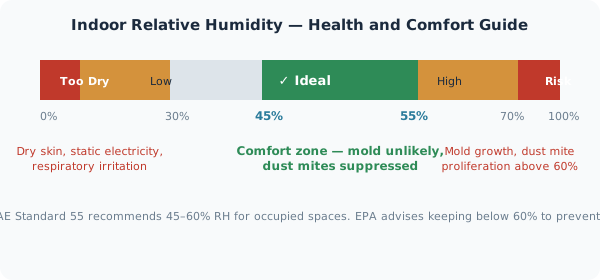
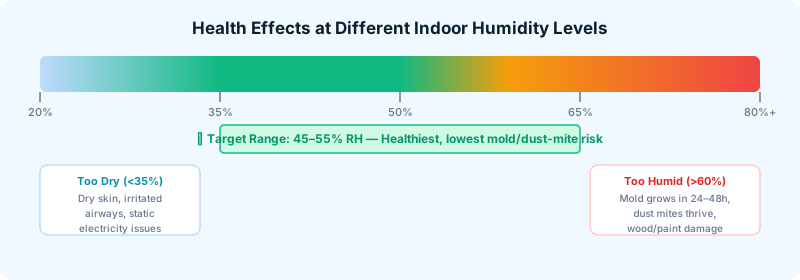
Mold prevention: The EPA and ASHRAE both state that indoor relative humidity should be kept below 60% to prevent mold growth. Mold spores are everywhere, they're airborne in every home. At humidity levels below 60%, those spores can't germinate on organic surfaces (wood, drywall, cardboard, fabric). Above 60%, germination begins within 24–48 hours on most organic materials.
Staying at 50% gives you a 10% buffer below the danger threshold. That matters because hygrometers aren't perfectly accurate (most are ±3–5% RH), humidity isn't uniform throughout a space, and humidity spikes after a shower or heavy rain can temporarily push readings higher.
Comfort and health: Below 30% RH, the air becomes dry enough to cause respiratory irritation, dry skin, nosebleeds, and cracked wood furniture. ASHRAE Standard 55 recommends 30–60% RH for occupied spaces, with 45–55% being the sweet spot for most people. At 45–50%, wood furniture and floors are stable (no swelling or shrinking), dust mites are suppressed (they need above 50% to reproduce well), and respiratory comfort is maintained.
The narrow target of 45–50% isn't arbitrary, it's genuinely the zone that satisfies all these constraints simultaneously.
What Happens Outside That Range
Below 35% RH: Dry air. You'll notice static electricity, chapped lips, dry nasal passages. Wooden floors gap and squeak. Musical instruments go out of tune faster. Fine art and antiques suffer. This level usually requires a humidifier in winter, not a dehumidifier.
35–45% RH: Acceptable but below ideal for comfort. Dust mites are suppressed. No mold risk. This is fine for basements where you're not spending significant time.
45–50% RH: Ideal. Comfortable, mold-suppressive, stable for wood and sensitive materials. Most healthy adults feel best here.
50–60% RH: Acceptable in short periods. Above 55%, dust mite reproduction accelerates. Above 60%, you're approaching mold germination territory.
Above 60% RH: Mold risk zone. Not safe for extended periods on organic materials. Many people can smell this level, that distinctive "musty" basement odor is the first sign.
How to Set Your Dehumidifier
Most modern dehumidifiers have a built-in humidistat that you set to your target RH. The unit monitors the room and runs when humidity rises above the set point.
Step 1: Set the humidistat to 50% RH. This is your starting point.
Step 2: Let the unit run for 24–48 hours and observe. If your hygrometer (you should have one, they're $12 at hardware stores) reads consistently between 45–55% during that period, your unit is sized correctly and the setting is dialed in.
Step 3: If the unit runs continuously for 48 hours and humidity doesn't drop below 55%, the unit is undersized for your space. Use our dehumidifier size calculator to check whether you need more capacity.
Step 4: If the unit reaches 50% in a few hours and then sits idle most of the day, it may be oversized, or your space is less humid than expected. Either way, that's fine, you're at target humidity.
Step 5: Seasonally adjust. In very humid summers, 50% may be hard to maintain without the unit running frequently. In fall and winter, you may want to raise the setting to 55–60% to avoid over-drying the basement air.
Basement vs. Living Area Settings
Basements can tolerate slightly higher humidity than finished living areas without causing comfort issues, you're generally not spending hours at a time in the basement. A 55% target in the basement is reasonable and extends unit lifespan by reducing run time.
For finished basements where you have drywall, wood framing, flooring, or furniture, keep it at 50% or below. Finished organic materials are more vulnerable to mold than bare concrete.
For crawl spaces, target 50% or below year-round. Crawl spaces are particularly vulnerable because the moisture load comes directly from soil, and the enclosed space concentrates it. Read our crawl space dehumidifier sizing guide for specific capacity recommendations.
Living areas (bedrooms, living rooms) during the heating season often drop below 40% RH because heated air is dry. In these spaces, you may need to add humidity in winter rather than remove it.
Using a Hygrometer to Verify
Your dehumidifier's built-in humidity reading is a rough guide, not a calibrated measurement. Most built-in sensors are accurate to ±5–8% RH. For a $12–$20 investment, a standalone hygrometer (also called a humidity meter or humidity monitor) gives you a more accurate independent reading.
Place the hygrometer:
- At breathing height (not on the floor, where readings are higher near concrete)
- Away from the dehumidifier itself (the air immediately around the unit will be drier than the room average)
- In the center of the space, not against an exterior wall
If your hygrometer consistently reads 5–10% higher than your dehumidifier's display, calibrate mentally: your actual humidity is closer to the hygrometer reading. Set the dehumidifier 5% lower to compensate.
Energy Cost of Different Settings
Running a dehumidifier at 45% instead of 50% means the unit works harder and runs more hours per day. In a very damp basement with a 35-pint unit, the difference might be 200–400 extra kWh per year, about $32–$64 at $0.16/kWh. Not enormous, but worth knowing.
In a moderately damp basement, 50% is achievable without excessive run time. In a very damp space, aiming for 45% may mean the unit runs nearly continuously in summer. 50% is a more realistic target. Prioritize reaching and maintaining a level below 60%, that's what matters for mold prevention. Fine-tuning between 45% and 55% has modest practical impact compared to making sure you're below 60%.
For annual operating cost estimates across different unit sizes and climates, see our breakdown of how much it costs to run a dehumidifier per month. If you haven't sized your unit yet, use our dehumidifier pint calculator, it accounts for your specific room type and climate zone. Learn more about our approach on the about page.