Buying a dehumidifier for your basement sounds simple, until you're standing in the appliance aisle staring at units labeled 20, 35, 50, and 70 pints, with no idea which one you actually need. Get it wrong and you're either running a unit 24/7 that never catches up, or spending $300 on a unit that short-cycles and sits idle half the day.
Here's how to get it right.
Start with Square Footage
The foundation of any dehumidifier sizing calculation is the area you want to condition. Measure your basement's length and width and multiply them. A 30×40 ft basement is 1,200 sq ft. If your basement has an L-shape or irregular layout, break it into rectangles and add the areas together.
Don't forget attached spaces that share the same air: a utility room connected to the main basement area should be counted in your total, even if it has a separate use. A door between them doesn't isolate the humidity, air flows underneath and around doors constantly.
Typical basement sizes:
- Small (under 500 sq ft): Studio apartment or townhouse basement
- Medium (500–1,000 sq ft): Standard 3-bedroom home
- Large (1,000–2,000 sq ft): Larger single-family home
- Extra large (2,000+ sq ft): Full finished basement or walkout
Identify Your Moisture Condition
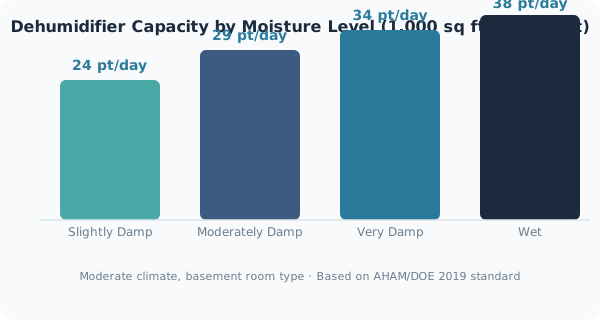
Square footage tells you how much air needs to be treated. The moisture condition tells you how intensely. AHAM classifies basement moisture into four levels:
Slightly damp: You notice a musty smell, but only on unusually humid days. No visible moisture on walls. This is the mildest condition and requires the least capacity.
Moderately damp: The musty smell is persistent, you notice it every time you go downstairs. There may be damp spots on concrete walls after heavy rain, condensation on cold pipes, or visible white mineral deposits (efflorescence) on foundation walls.
Very damp: Visible moisture on walls and floor. Active seepage after rain. The basement may feel clammy even in dry weather. You've probably noticed rust on metal objects stored down there.
Wet: Standing water, a documented flooding history, or water actively entering the space during or after rain. This requires the most capacity and may also require waterproofing work, a dehumidifier alone can't solve an active water intrusion problem.
Most homeowners have moderately damp basements. If you're unsure, run a simple test: tape a 12×12 inch piece of plastic sheeting to the concrete wall, seal all four edges with tape, and leave it for 48 hours. Moisture behind the plastic means water is migrating through the wall from the soil.
Apply the Room-Type Multiplier
Basements need more dehumidification per square foot than above-grade rooms of the same size. Why? They're surrounded by soil, which releases moisture vapor continuously through a process called vapor diffusion. Below-grade concrete walls are rarely vapor-tight. Even with no visible leaks, water vapor moves through concrete.
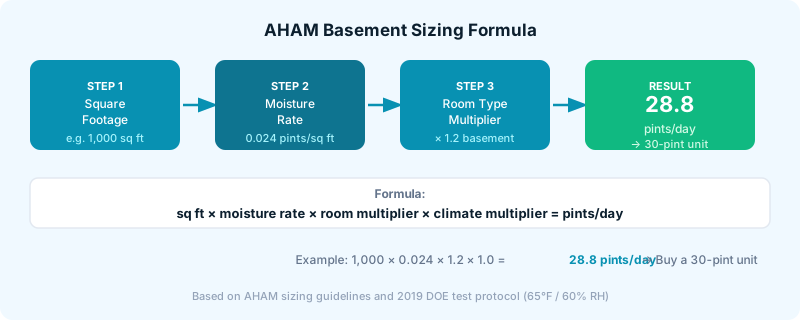
The AHAM/DOE framework applies a 1.2× multiplier to basements, meaning you need 20% more capacity than a simple area calculation would suggest. For very damp conditions with active seepage, that multiplier effectively stacks with your moisture-condition rate to push recommendations higher.
This is why a 1,000 sq ft basement in moderate conditions requires roughly 29 pints/day, while a 1,000 sq ft living room with the same moisture level would only need around 24 pints/day.
Factor in Your Climate
A basement in Minneapolis and a basement in New Orleans have very different dehumidification needs, even if they're the same size and moisture level. Humid climates have higher outdoor dew points, which means more moisture infiltrating the space from outside air. The unit also needs to run more days per year.
Climate multipliers used in the calculation:
- Dry/arid (Southwest US): 0.8× multiplier; unit runs ~90 days/year
- Moderate (Midwest, West Coast): 1.0× baseline; ~150 days/year
- Humid (Southeast, Gulf Coast): 1.15× multiplier; ~180 days/year
- Very humid (Tropical, Coastal): 1.3× multiplier; unit runs ~210 days/year
A homeowner in Atlanta with a 1,200 sq ft moderately damp basement should size for about 40 pints/day. The same homeowner in Denver with the same basement would size for 28 pints/day. Use our dehumidifier size calculator to plug in your exact numbers.
What the Post-2019 DOE Standard Means for Buying
If you're replacing a dehumidifier purchased before 2020, you'll notice the labels look smaller. A unit you remember as "70 pints" will now appear as roughly "50 pints" in the new standard. The unit didn't change, the test conditions did.
Before 2019, manufacturers tested at 80°F and 60% RH, warm enough that units removed moisture quickly and posted impressive ratings. The DOE updated the standard to 65°F/60% RH, which better reflects actual basement conditions. At 65°F, units remove less moisture per hour, leading to lower (and more honest) capacity ratings.
Practical impact: if you're replacing an older pre-2019 unit, the new equivalent is roughly 70% of the old stated capacity. Replacing a "50-pint" pre-2019 unit? Look for a 35-pint unit under the current standard. They're actually the same real-world performer.
Practical Sizing Examples
Here are a few common scenarios to benchmark against:
Small 400 sq ft laundry/utility room, moderately damp, moderate climate: ~12 pints/day. A 20-pint unit is the right choice.
800 sq ft basement, moderately damp, moderate climate: ~23 pints/day. A 30-pint unit works well; 35-pint gives comfortable headroom for bad weather days.
1,200 sq ft basement, very damp, humid climate (Southeast): ~50 pints/day. You need a 50-pint unit, don't try to get by with a 35-pint here.
2,000 sq ft finished basement, moderately damp, very humid (Florida): ~68 pints/day. A 70-pint unit or two 35-pint units positioned at opposite ends.
Use our basement dehumidifier calculator to get your specific recommendation with energy cost estimates included.
Where to Place the Unit
Sizing is only half the equation. Placement affects how well even a correctly sized unit performs. Position your dehumidifier:
- Near the center of the basement, not tucked in a corner
- At least 6 inches from walls (needs airflow on intake and exhaust sides)
- Away from cold exterior walls (the unit draws in warm humid air; cold walls create condensation that the unit then has to work harder to remove)
- Near a floor drain or with a gravity drain hose if possible, emptying the tank manually every day becomes a chore quickly
If your basement has separate zones divided by walls, consider whether air can flow between them. A 1,500 sq ft basement divided into two sealed rooms by a wall with a closed door effectively needs two dehumidifiers, one per zone. For more on this topic, see our guide on where to place your dehumidifier for optimal results.
Maintenance That Keeps the Unit Running Right
A correctly sized unit running inefficiently might as well be undersized. Keep it performing:
- Clean the filter every 2–4 weeks during heavy-use months
- Empty the tank or check the drain hose monthly for clogs
- Wipe down coils annually with a soft brush (unplug first)
- Store the unit upright, laying it on its side can damage the compressor
Most ENERGY STAR dehumidifiers last 8–12 years with reasonable maintenance. The annual operating cost on a 35-pint ENERGY STAR unit in a moderate climate runs about $100–$115/year at $0.16/kWh, a worthwhile investment to protect against mold, structural moisture damage, and the health risks of chronically high indoor humidity. For a detailed look at running costs, read our breakdown of dehumidifier energy costs per month.
Our dehumidifier sizing tool takes the guesswork out of this. Enter your room's details and get a recommendation in seconds, including the annual operating cost so you can compare models accurately before you buy.