Crawl spaces are the most challenging humidity problem in residential buildings. They're below grade, often uninsulated, potentially with exposed earth floors, and invisible to most homeowners until damage has already occurred. Getting dehumidification right in a crawl space requires understanding why it's harder than a basement, and sizing accordingly.
Why Crawl Spaces Need More Capacity
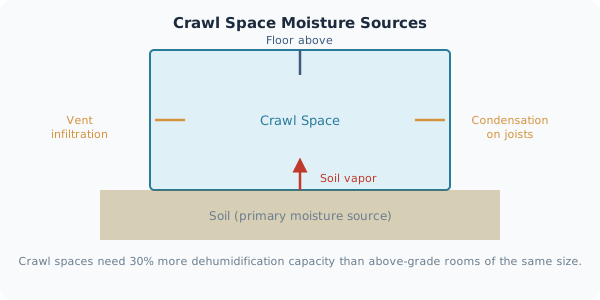
The standard AHAM/DOE framework applies a 1.3× multiplier to crawl spaces, the highest room-type adjustment in the calculation. This reflects three specific challenges that don't exist in above-grade rooms:
Soil vapor diffusion. An unsealed crawl space floor is in direct contact with moist earth. Water vapor migrates upward through capillary action and vapor pressure differences year-round, regardless of season. In summer, warm humid outdoor air infiltrates vents and contacts cooler below-grade surfaces, condensing immediately. In winter, the moisture gradient reverses, soil vapor still moves upward, but through cold air.
Joist and subfloor exposure. The floor joists, subfloor plywood, and any insulation between the joists in your crawl space are directly exposed to crawl space air. At 70% RH, wood moisture content rises toward 16–18%, the threshold where fungal growth (including mold and wood rot) begins. At 85% RH+, which is common in uncontrolled crawl spaces during summer, wood moisture content can exceed 20%, and wood rot becomes active within weeks.
Limited air circulation. A crawl space isn't conditioned by your HVAC system (unless you have an encapsulated crawl space with dedicated HVAC supply). The air inside is stagnant and stratified. A dehumidifier placed in one corner services that corner; the rest of the space may still be at 80%+ RH. Placement and number of units matters more here than in a basement.
Sizing: The Calculation
Use our dehumidifier size calculator and select "Crawl Space" as the room type. This applies the 1.3× multiplier automatically. Here's what that means in practice:
Example 1: 400 sq ft crawl space, moderately damp, moderate climate
- Base rate: 400 × 0.024 (moderately damp) = 9.6 pts
- Crawl space multiplier: 9.6 × 1.3 = 12.5 pts
- Climate factor (moderate, 1.0×): 12.5 pts/day
- Recommendation: 20-pint unit
Example 2: 800 sq ft crawl space, very damp, humid climate (Southeast)
- Base rate: 800 × 0.028 (very damp) = 22.4 pts
- Crawl space multiplier: 22.4 × 1.3 = 29.1 pts
- Climate factor (humid, 1.15×): 29.1 × 1.15 = 33.5 pts/day
- Recommendation: 35-pint unit, or 30-pint with drainage
Example 3: 1,400 sq ft crawl space, wet (soil exposed, active seepage), very humid climate
- Base rate: 1,400 × 0.032 (wet) = 44.8 pts
- Crawl space multiplier: 44.8 × 1.3 = 58.2 pts
- Climate factor (very humid, 1.3×): 58.2 × 1.3 = 75.7 pts/day
- Recommendation: 70-pint unit, or two 35–50 pint units
Vented vs. Encapsulated Crawl Space
Before sizing the dehumidifier, you need to decide which approach you're taking, because it changes the problem you're solving.
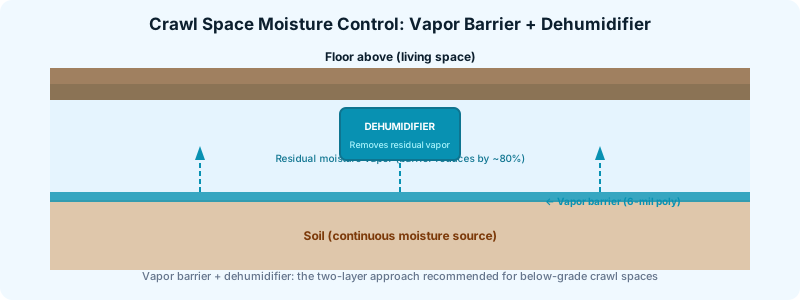
Vented crawl space: Foundation vents allow outdoor air to circulate through the crawl space. The original theory was that this ventilation would carry moisture out. In practice, venting a crawl space in humid climates makes humidity worse, warm humid outdoor air rushes in through vents, contacts cooler surfaces, and condenses. A dehumidifier in a vented crawl space is fighting a constant influx of outdoor moisture through those vents.
This is solvable, but requires a larger unit because the moisture load is continuous. You're not just dealing with soil vapor, you're also conditioning outdoor air entering through the vents.
Encapsulated crawl space: A vapor barrier (typically 12–20 mil reinforced polyethylene) covers the floor and is sealed to the foundation walls and piers. Foundation vents are sealed. The crawl space becomes a semi-conditioned space. Moisture load drops dramatically because the primary source (soil vapor) is blocked.
In an encapsulated crawl space, you need a smaller dehumidifier because the 1.3× multiplier overstates the actual load. Some building scientists argue that a properly encapsulated crawl space in a moderate climate doesn't need a dehumidifier at all. The conditioned air from the HVAC system (via a small supply duct or transfer grille) maintains adequate conditions.
The choice comes down to cost and commitment: encapsulation typically costs $2,000–$8,000 depending on size and condition, but solves the problem at the source. A dehumidifier alone manages the symptom ongoing.
Dehumidifier Requirements for Crawl Spaces
Crawl space dehumidifiers have different requirements than basement units. Standard portable units can work, but purpose-built crawl space units offer significant advantages:
Low-profile design. Crawl spaces often have 24–36 inch clearances. Standard upright dehumidifiers that stand 24+ inches tall won't fit. Low-profile units designed for crawl spaces are horizontal and fit in spaces as low as 22 inches.
Low-temperature operation. Standard dehumidifier coils begin to freeze below 60°F. That's a significant problem in a crawl space that may be 55–58°F year-round. Crawl space units use defrost cycles or hot gas defrost to operate down to 35–45°F.
Integrated pump. Manually emptying a dehumidifier tank in a crawl space is impractical. A unit with a built-in condensate pump that drains to outside or a sump pump is essential.
Energy Star certification. Given year-round operation in many climates, efficiency matters. Look for an IEF (Integrated Energy Factor) of at least 2.8 L/kWh for crawl space units.
Placement in Crawl Spaces
One dehumidifier may not be sufficient for large or irregularly shaped crawl spaces. Guidelines:
- Place in the center if a single unit, maximizes coverage
- For long, narrow crawl spaces (e.g., 15 ft wide × 80 ft long), two units positioned at opposite ends work better than one unit in the center
- Aim the exhaust toward the middle of the space, not at the vapor barrier or walls
- Keep at least 12 inches from foundation walls
- Ensure condensate drain line flows by gravity or pump to an appropriate drain
For large crawl spaces (over 1,500 sq ft), two units gives you redundancy, if one unit fails, you're not without protection entirely during a humid season.
When to Add Encapsulation
If your hygrometer in the crawl space consistently reads above 70% even with a properly sized and running dehumidifier, the unit is fighting more moisture than it can win against. At that point, encapsulation becomes worth serious consideration.
Signs encapsulation is necessary:
- Standing water appearing after rain despite good exterior drainage
- Visible mold on joists or subfloor in multiple locations
- Musty odor in the home's living areas (crawl space air infiltrates upward)
- Wood moisture content above 19% (checked with a pin-type moisture meter)
A dehumidifier is a maintenance tool, not a remediation tool. If the underlying moisture problem is severe enough, you fix the building first, encapsulation, exterior drainage, sump pump, then add the dehumidifier as ongoing protection. See our mold prevention guide for context on what a dehumidifier can and can't do in active moisture situations.
Once you've addressed the source, the crawl space capacity calculator gives you the right pint rating for ongoing protection.