Before you buy a dehumidifier, it's worth knowing what you're signing up for in ongoing costs. The upfront price is obvious. The electricity bill addition is less so, but it matters, especially if you're running the unit 6–8 months per year.
The numbers are more reasonable than most people expect. Here's the full breakdown.
The Core Variables
Your dehumidifier's electricity cost depends on four things:
1. Unit wattage, larger units use more power per hour
2. How many hours per day it runs, depends on how damp your space is
3. How many days per year it runs, depends on your climate
4. Your local electricity rate, US average is $0.16/kWh; varies $0.10–$0.28 regionally
These combine to produce a surprisingly manageable number for most homeowners.
Wattage by Dehumidifier Size
Dehumidifier wattage is roughly proportional to pint capacity. ENERGY STAR-certified units are more efficient than standard units, so look for the ENERGY STAR label when buying, it cuts operating cost by 15–30%.
Approximate wattage ranges:
- 20-pint unit: 220–300 watts
- 30-pint unit: 300–430 watts
- 35-pint unit: 380–500 watts
- 50-pint unit: 550–750 watts
- 70-pint unit: 700–1,000 watts
A 35-pint ENERGY STAR unit draws about 420 watts. Running at 12 hours/day (50% duty cycle assumed in the 2019 DOE standard), that's 420W × 12h = 5.04 kWh/day.
Calculating Monthly and Annual Cost
The formula: kWh/day × run days/month × $/kWh = monthly cost
Using a 35-pint ENERGY STAR unit at $0.16/kWh:
- At 50% duty cycle: 5.04 kWh/day
- Moderate climate, runs ~150 days/year (~12 months, ~12.5 days/month): 5.04 × 12.5 × $0.16 = $10.08/month during active season
- Annual total: 5.04 × 150 × $0.16 = $120.96/year
That's about the same as running a medium-sized refrigerator. For a 50-pint unit in the same climate, expect $160–$180/year.
Monthly Cost by Climate Zone
Climate is the biggest variable in operating cost because it determines run days. A dehumidifier in Phoenix may run 90 days/year; one in New Orleans may run 210 days.
35-pint ENERGY STAR unit at $0.16/kWh:
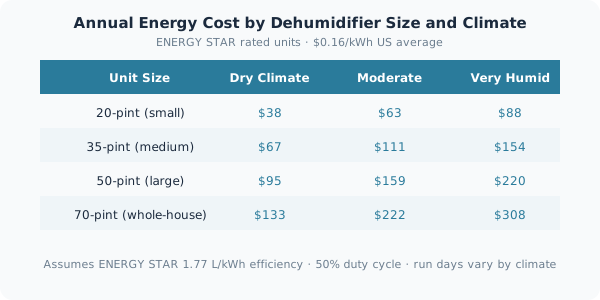
| Climate Zone | Run Days/Year | Monthly Cost (Active Season) | Annual Cost |
|---|---|---|---|
| Dry/Arid (SW US) | ~90 days | ~$6/month | ~$67 |
| Moderate | ~150 days | ~$10/month | ~$111 |
| Humid (Southeast) | ~180 days | ~$12/month | ~$138 |
| Very Humid (Tropical) | ~210 days | ~$15/month | ~$166 |
These estimates assume the unit runs at 50% duty cycle, 12 hours per day. In a very damp space, duty cycle can be higher; in a slightly damp space, lower.
ENERGY STAR vs. Non-Certified Units
The ENERGY STAR program requires dehumidifiers to meet minimum efficiency thresholds called Integrated Energy Factor (IEF), measured in liters of moisture removed per kWh consumed. As of 2024, ENERGY STAR requires at least 1.77 L/kWh for 30-pint class units.
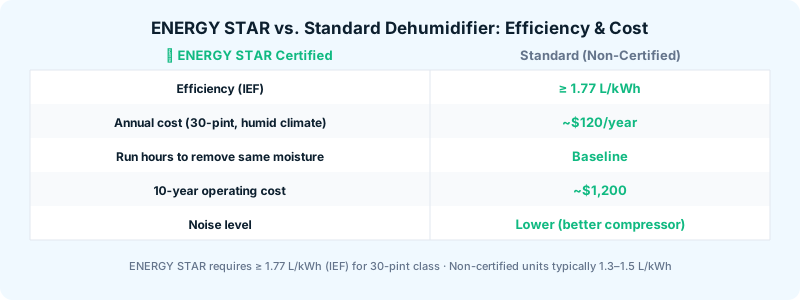
A non-certified unit in the same pint class might operate at 1.3 L/kWh, removing less moisture per unit of energy consumed. That means it needs to run more hours to achieve the same result, increasing cost by 25–35%.
Over a 10-year dehumidifier lifespan, choosing ENERGY STAR over a non-certified unit saves roughly $300–$600 in electricity. The ENERGY STAR premium at purchase (usually $20–$50) pays back in year one or two.
Electricity Rate Variations
The national average of $0.16/kWh is a reasonable starting point, but actual rates vary significantly:
- Below average ($0.10–$0.12/kWh): Parts of the South and Midwest, Oklahoma, Louisiana, Texas, Kansas
- Average ($0.13–$0.17/kWh): Most of the Midwest and Southeast
- Above average ($0.18–$0.24/kWh): Northeast, California, Pacific Northwest (paradoxically, due to distribution costs)
- Very high ($0.24–$0.28/kWh): Hawaii, Connecticut, Massachusetts
To use your actual rate: find it on your electricity bill (look for "Energy Charge" in $/kWh). Then multiply: (unit wattage / 1000) × run hours × days × your rate.
Comparing to the Cost of Not Running One
The operating cost of a dehumidifier looks different when compared to what happens without one:
Mold remediation: $1,500–$5,000 for a typical basement mold problem. A dehumidifier running for 10 years at $150/year costs $1,500, roughly the minimum remediation cost for a mold problem it would have prevented.
Structural damage: Chronic basement moisture causes wood rot in framing, subfloor, and joists. Repairing rotted floor joists runs $500–$3,000 depending on extent.
HVAC efficiency: High basement humidity increases the load on your air conditioner when it does run, slightly raising cooling costs. A basement maintained at 50% RH vs. 75% RH meaningfully reduces the moisture load your HVAC system has to handle.
Sizing Right to Control Cost
Running an undersized unit at 80–100% duty cycle 24/7 doesn't just wear out the unit faster, it also costs more than running a correctly sized unit at 40–50% duty cycle. The correctly sized unit reaches target humidity and backs off; the undersized unit never does.
Use our dehumidifier size calculator to find the right pint capacity for your space before buying. If you're in a humid climate with a large damp basement, sizing up to a 50-pint unit often makes more sense than running two smaller units. The 50-pint unit's higher efficiency and lower combined duty cycle can make it cheaper to operate than two 25-pint units working harder.
For help sizing your unit, see our basement dehumidifier sizing guide, and once you have your unit running, check our article on what RH level to target to avoid running the unit harder than necessary. Learn about our methods on our about page.