You bought the right size dehumidifier. You set it to 50% RH. Two weeks later, one corner of your basement is comfortable and the other still smells musty. The problem might not be the unit, it might be where you put it.
Placement determines how much of a space the dehumidifier can actually service. Here's how to position it correctly.
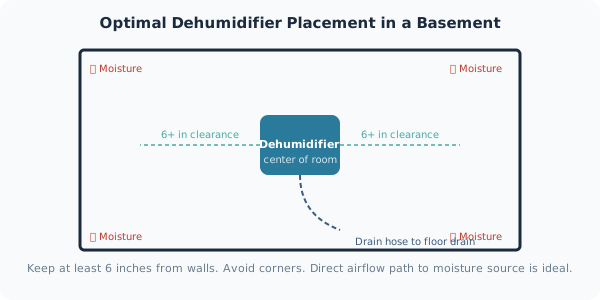
The Core Rule: Center of the Space
A dehumidifier draws in air through its intake (usually one side or the back), removes moisture, and exhausts drier air out the other side. It conditions the air immediately around it first, and relies on natural air circulation to spread that effect to the rest of the space.
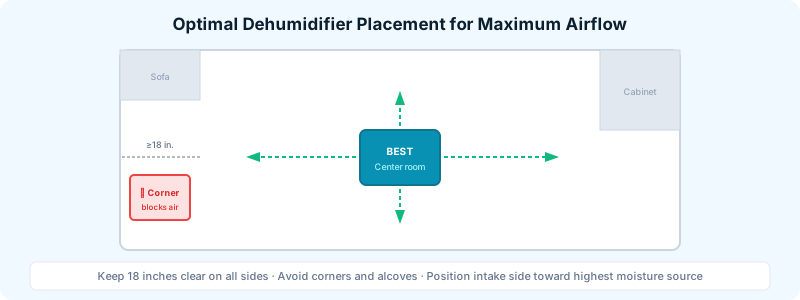
Put the unit in the center of the room, not in a corner. A dehumidifier jammed into a corner has two walls blocking airflow on two sides. It will dehumidify that corner effectively while the rest of the room remains humid. Centering the unit maximizes the reach of its conditioned air output.
If "center" isn't practical due to floor drains, columns, or storage layout, position the unit with clear airflow paths in at least two directions.
Clearance Requirements
Every dehumidifier needs clear space around it for adequate airflow. General guidelines:
- Intake side: 6–12 inches minimum clear space (check your unit's manual, some require more)
- Exhaust side: 6–12 inches minimum; some manufacturers recommend 24 inches for optimal performance
- Above: At least 12 inches of clear space; don't place items on top of the unit
- Floor: Units should sit on a flat, level surface. Uneven placement affects internal drainage
The exhaust direction matters. Point the exhaust (where dry air comes out) toward the center of the room or the most moisture-prone areas, typically the wall with foundation contact or the area below the stairs, which often sees moisture from above.
Distance from Moisture Sources
Counterintuitively, you don't want to put the dehumidifier right next to the wettest wall. Here's why: the unit dehumidifies air, not surfaces. If it's right against a seeping wall, it draws in saturated air immediately from one source. Pull it back 6–8 feet from the problem wall, it will service the air in a wider radius, drawing from the entire space, not just one concentrated source.
Exception: if you have an active water drip or pool, a unit directly adjacent can help manage it while you fix the underlying issue. But this is emergency management, not optimal placement.
Humidity Stratification
Humidity in basements isn't uniform. It's highest near the floor (where concrete meets soil vapor) and near exterior walls. It's lower near the center of the room at chest height.
Your dehumidifier's intake should be at room-air level, not pressed against the floor or elevated near the ceiling. Most units sit on the floor and intake air at their front or back; that's intentional. Don't elevate the unit on shelving or blocks unless the manufacturer specifically recommends it.
If your basement has very high ceilings (8+ feet), consider positioning with the intake facing the most problematic wall, so the unit is drawing the most moisture-laden air first rather than conditioning the drier upper air.
Divided Spaces and Multiple Units
If your basement has separate zones, divided by a solid wall, a closed door, or a tight partition, humidity doesn't circulate freely between them. Each zone is its own air space for dehumidification purposes.
One dehumidifier can only effectively service an open-plan space. Once a solid wall separates zones, you need a unit in each zone. A 1,500 sq ft basement with an open floor plan is one zone; the same basement divided into three rooms by drywall walls with closed doors is three zones requiring three units.
The same principle applies to crawl spaces with multiple sections separated by foundation piers, knee walls, or debris. Position a unit in the largest open section and run a duct or use a separate unit for separated sections.
Drain Hose vs. Manual Tank Emptying
Placement is directly tied to drainage. If you're manually emptying the tank, the unit must be near a path you can access easily, and you'll need to empty it daily or every 12–18 hours in humid conditions. That's a commitment most homeowners find unsustainable.
A gravity drain hose is the practical solution. Most units have a threaded drain port that accepts a standard garden hose. Run the hose to a floor drain, utility sink, or sump pit. The unit drains continuously without any attention needed.
For gravity drainage to work, the hose must run continuously downhill from the unit to the drain. The dehumidifier should sit higher than the drain point. If your basement has no floor drain, or if the unit position doesn't allow gravity drainage, look for a unit with a built-in condensate pump, it can push water upward through a smaller tube to a nearby sink or utility drain.
Placement flexibility increases dramatically with a pump-equipped unit. You can position it in the optimal center-room location regardless of where the floor drain is.
Basement with Stairs and Obstruction Layouts
Stairs, support columns, HVAC equipment, and water heaters all complicate placement. Practical adjustments:
Under the stairs: Fine for the space immediately around it, but stairs often sit against exterior walls. If the stairs are in a corner, this is the worst-case placement scenario. Use as a last resort.
Next to HVAC equipment: Generally fine; the area around mechanical equipment often has good airflow. Keep the dehumidifier's intake clear of the furnace exhaust flue and any combustion appliances.
Central column: If a support column sits in the center of your basement, position the dehumidifier equidistant from two walls on one side of the column, with the exhaust pointing toward the column, the air will deflect and circulate. For large basements with multiple columns, two units positioned at the midpoints of each half of the basement outperform one large unit in the center.
Crawl Space Placement Specifics
Crawl spaces add unique constraints. See our crawl space dehumidifier guide for detailed sizing, but for placement:
- Horizontal units: Standard upright dehumidifiers often don't fit. Purpose-built crawl space units are horizontal and fit in 22–24 inch clearance spaces.
- Access point proximity: Position the unit within reach of where you enter the crawl space for filter cleaning and maintenance. You'll need to access it regularly.
- Vapor barrier: If encapsulated, the unit should sit on the vapor barrier (elevated on a small platform), not on bare earth.
- Multiple access: If your crawl space is very long and narrow, two smaller units at opposite ends outperform one large unit in the middle.
Verifying Placement Works
After positioning, check your results with a hygrometer, not just the unit's built-in display. Place the hygrometer at the far end of the space from the dehumidifier. If humidity there drops to within 5–8% of the unit's display, placement is working. If the far end stays significantly wetter than the unit's reading, the dehumidifier isn't circulating effectively through the whole space.
Use our dehumidifier size calculator if you're unsure whether you have enough capacity for the size of the space you're trying to condition, correct placement of an undersized unit still won't reach target humidity in a large, damp space. For seasonal timing of when to run the unit, see our seasonal dehumidifier guide.