Your AC removes some humidity. Your dehumidifier removes a lot of humidity. They're not the same tool, and using the wrong one for the job leads to either an uncomfortable home or a damaged one.
Here's the practical breakdown of what each does, where each excels, and when you need both.
How Each Device Removes Moisture
Both devices use refrigerant-based cooling coils to pull moisture from air. The physics is the same: warm humid air hits a cold surface, moisture condenses, and falls into a drain. The difference is in intent and what happens to the air afterward.
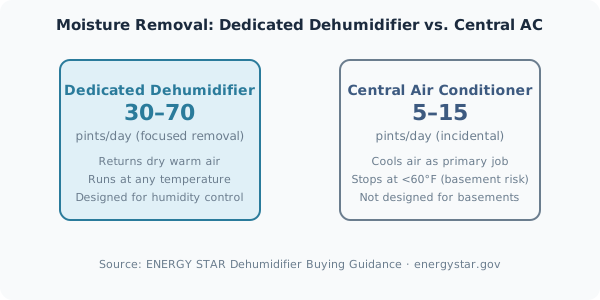
Air conditioner: The primary goal is cooling. The AC pulls warm humid air in, passes it over cold evaporator coils (removing heat and some moisture), then pushes the now-cooler, somewhat drier air back into the room. The moisture drains outside through the condensate line. As a side effect, it does reduce humidity, but only while it's cooling. When the thermostat is satisfied, the AC shuts off, even if humidity is still high.
Dehumidifier: The primary goal is moisture removal. Air passes over cold coils, moisture condenses and drips into a tank (or drain hose), and then the air is reheated by passing over the condenser coils before being returned to the room. This is critical: a dehumidifier returns warm dry air, not cold dry air. The room temperature actually rises slightly when a dehumidifier runs.
How Much Moisture Does Each Remove?
This is where the gap becomes stark.
A central air conditioner might remove 5–15 pints of moisture per day as a byproduct of cooling, it varies wildly based on the unit's size, how long it runs, and outdoor conditions.
A 35-pint ENERGY STAR dehumidifier removes exactly 35 pints per day under the 2019 DOE test conditions (65°F/60% RH). A 50-pint unit removes 50 pints. That's 3–10 times more moisture removal than your AC.
More important: a dehumidifier runs independently of temperature. Your AC stops running when the house hits 68°F, but your basement could still be at 75% RH. The dehumidifier keeps working regardless of temperature, triggered by a humidistat.
When Your AC Is Enough
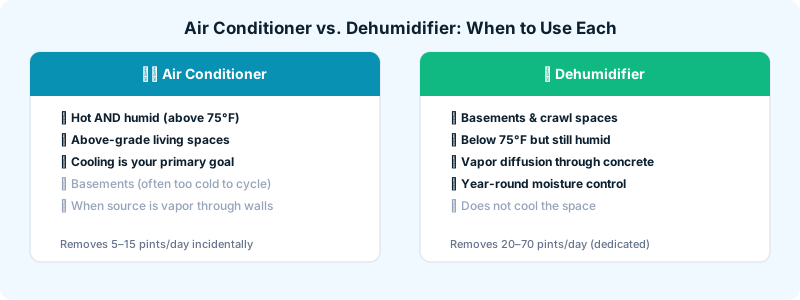
For above-grade living spaces in moderate climates during summer, air conditioning alone usually keeps humidity under control. When the AC runs frequently, say, 8–12 hours per day in a hot summer, it's removing meaningful moisture as a byproduct of keeping things cool.
You'll know your AC is handling humidity if:
- Indoor RH stays below 55% during typical summer days
- The space feels comfortable at your set temperature
- No musty smell or condensation on windows
If your AC is correctly sized for your home and runs regularly, you may not need a supplemental dehumidifier for living areas. Problems start when the AC is oversized (cools too quickly, short-cycles, doesn't run long enough to dehumidify), or when you're trying to condition a below-grade space where the AC doesn't reach.
Why AC Fails in Basements
Basements have two problems that make AC-based dehumidification unreliable:
Temperature: Basements often sit at 60–65°F year-round without HVAC conditioning. Most AC systems don't cool below the set point, if your thermostat is at 72°F and the basement is already at 64°F, the AC doesn't run down there at all. No cooling cycle means no incidental moisture removal.
Below-grade moisture: Basement humidity comes largely from moisture migrating through concrete walls and floors, a source completely unrelated to outdoor air temperature. You can't cool your way out of vapor diffusion through a concrete foundation. The moisture source exists whether it's summer or winter, hot or cold.
This is why a dedicated dehumidifier with its own humidistat is the only reliable solution for basement moisture control. Our basement dehumidifier sizing guide walks through how to pick the right pint capacity for your specific space.
The Overcooled-House Problem
An oversized air conditioner is surprisingly common, and it creates a humidity nightmare. An oversized AC cools the house quickly and shuts off before it's had time to dehumidify the air. The house feels cool but clammy, 74°F at 70% RH is less comfortable than 76°F at 50% RH.
If your house is always cool but never feels dry, this could be your problem. Solutions include:
- A variable-speed or two-stage AC that runs longer at lower output (removes more moisture)
- A whole-house dehumidifier installed in the HVAC return
- A portable dehumidifier in the problem areas
When You Need Both
In humid climates (Southeast US, Gulf Coast, Florida), most homes need both systems working together. The AC handles temperature and provides meaningful incidental dehumidification in living areas. The dehumidifier handles the basement and any above-grade areas where the AC can't keep RH below 55% on its own.
Signs you need to add a dehumidifier even if you have AC:
- Basement RH consistently above 60% in summer (check with a hygrometer, they cost about $12)
- Musty smell anywhere in the house
- Condensation on basement walls or floor
- Wood floors cupping or swelling
- Allergy symptoms worse at home than outside
Use our dehumidifier capacity calculator to size a unit for your specific space. For basements, the AHAM framework accounts for below-grade moisture loads that AC systems aren't designed to handle. For more on target humidity levels, see our guide on what humidity level to set your dehumidifier.
Cost Comparison
Running a 35-pint ENERGY STAR dehumidifier in a moderate climate costs about $111/year. Running a central AC to provide the same humidity control in a basement would cost far more in electricity, if it worked at all, which it often doesn't in below-grade spaces.
A dehumidifier is purpose-built for this problem. It costs $150–$400 upfront and solves the specific issue of excess moisture in a defined space. Compare that to the alternative, mold remediation, which runs $1,500–$5,000 depending on severity, and it's an obvious investment.
For a detailed breakdown of annual operating costs by unit size and climate, see our article on dehumidifier energy costs and monthly operating expenses. And if you're dealing with active mold, read our guide on whether a dehumidifier can prevent mold growth, the answer involves some nuance about timing and what the unit can and can't do.