Most homeowners run their dehumidifier whenever they think about it. That approach leads to either inadequate humidity control during the seasons it matters most, or unnecessary electricity costs running it during months when it does nothing useful.
Timing matters. Here's how to think about it by season and by where you live.
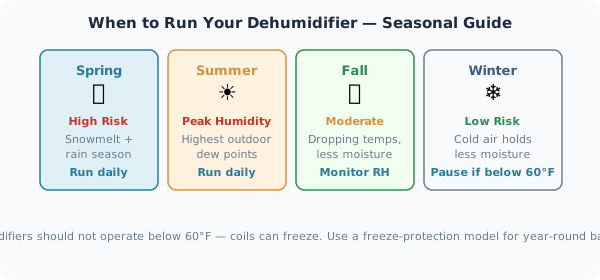
Why Season Matters: The Dew Point Explanation
Humidity in your basement doesn't just come from inside, most of it infiltrates from outside air and soil. In summer, warm outdoor air carries large amounts of moisture (high dew point). When that air enters your cooler basement, the moisture condenses on walls, pipes, and floors. This is the primary mechanism that makes basements humid in summer.
In winter, the pattern reverses. Cold outdoor air, even at 80% RH, contains very little actual moisture because cold air has low moisture-holding capacity. When that dry cold air infiltrates your basement, it actually dries the space out rather than humidifying it.
The practical result: summer is when your dehumidifier earns its keep. Winter is when it may be less useful, or even harmful to run (more on that below).
Spring: Start Early
Spring is consistently underestimated. Snowmelt, spring rains, and rising water tables combine to make spring one of the wettest periods for basements. Add in the fact that outdoor dew points are rising, from the dry winter lows toward summer peaks, and you have the conditions for rapid humidity buildup.
Start your dehumidifier in early spring, typically:
- Northern US (Zones 5–7): March or April, when outdoor temps consistently exceed 55°F
- Mid-Atlantic and Southeast: February or March
- Deep South and Florida: The unit may run year-round; spring is just a continuation
Don't wait until you see visible moisture or smell mustiness, at that point, the humidity has been elevated long enough to potentially start mold germination. A hygrometer in the basement gives you the signal: when readings hit 55–60%, start the unit.
Summer: Peak Operation Season
Summer is when basements are at their worst in most US climates. Outdoor dew points in the Midwest and Northeast routinely reach 65–70°F in July and August. Every time outdoor air infiltrates the basement, through foundation cracks, vent openings, utility penetrations, it carries enormous moisture loads.
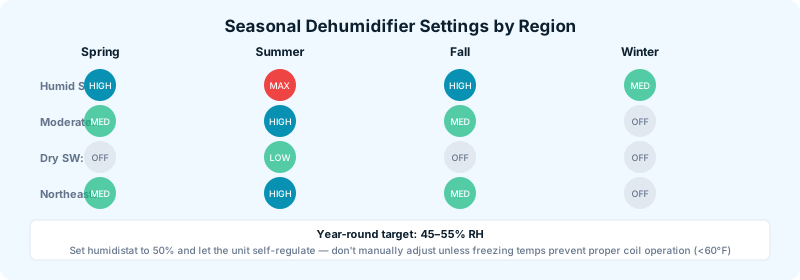
Run your dehumidifier continuously during summer, letting the humidistat do the work. Set it to 50% RH and let the unit cycle on and off as needed. In a severely damp basement or crawl space in a humid climate, the unit may run 18–20 hours per day during peak summer weeks.
If you're finding that the unit runs continuously without reaching your target humidity, it's either undersized for the space or the moisture source is overwhelming it. Use our dehumidifier size calculator to verify you have the right pint capacity. An undersized unit running continuously costs more in electricity and wears out faster than a correctly sized unit running at 50–60% duty cycle.
Signs you need more capacity:
- Unit runs more than 20 hours per day in average weather
- Humidity rarely drops below 65% despite the unit running
- The tank fills in under 8 hours repeatedly
Fall: Transition and Tapering
As temperatures drop below 65–70°F consistently, outdoor dew points fall. Less moisture is infiltrating from outside, and the basement naturally dries out relative to summer. Your dehumidifier should run less frequently.
Keep the unit running on humidistat control through fall; it'll automatically run less as conditions improve. Watch your hygrometer: when it consistently reads below 50% RH without the unit running, you can reduce monitoring or start thinking about seasonal shutdown.
In northern climates, this typically happens in September–October. In the South, fall conditions may not be reached until November or December.
Caution: fall can bring extended rainy periods with high humidity that temporarily reverses the drying trend. Don't shut off the unit prematurely; let the humidistat earn its keep through the variable conditions of September and October.
Winter: Pause or Reduce Operation
This is where most advice gets oversimplified. "Run it year-round" is wrong for most climates and most units. "Turn it off all winter" is correct for many situations but has exceptions.
Standard portable dehumidifiers should NOT run below 60°F. The evaporator coils will frost over when air temperature drops below 60°F because the coils are colder than the frost point at that temperature. The dehumidifier control will detect this, defrost, and cycle, but it's working inefficiently and potentially damaging the compressor over time. Most standard units have automatic shutoff below 60°F.
Check your basement temperature in winter. If it's 58°F, your standard dehumidifier should be off.
Exception: low-temperature or crawl space units. Purpose-built crawl space dehumidifiers and some cold-climate basement units operate reliably down to 33–45°F using hot-gas defrost or other cold-weather designs. If you have one of these units, year-round operation is reasonable in all climates.
Exception: very damp spaces. A basement with active water intrusion (not just vapor infiltration) may need year-round dehumidification even in winter. If your basement has standing water after snowmelt or rain in February, humidity control is still a real concern regardless of air temperature.
Exception: Gulf Coast and tropical climates. If you're in Florida, Louisiana, or coastal Georgia, outdoor dew points stay high even in "winter." Your basement may be warm enough that the unit runs fine, and winter humidity may still reach problematic levels. Let the humidistat guide you, if it reads above 60% in January, the unit should be running.
Year-Round Humidity Monitoring
The simplest system: put a digital hygrometer (humidity monitor) in your basement. These cost $12–$20 at hardware stores. Check it monthly in winter, weekly in spring/fall, and daily or automatically via a smart hygrometer in summer.
Target ranges by season:
- Summer: 45–50% RH
- Spring/Fall: 50–55% RH acceptable
- Winter: 50–60% acceptable; below 40% may indicate you need a humidifier instead
If you don't have a dehumidifier yet and want to understand what size to buy for your space, our dehumidifier pint capacity calculator handles all the variables, including your climate zone, which directly affects how many days per year your unit will need to run. That runtime directly affects annual operating cost, which you can see in our dehumidifier energy cost breakdown.
What Happens If You Run It at the Wrong Time
Running when it's too cold: Coil icing, inefficient operation, potential compressor damage over time. Wasted electricity with minimal moisture removal.
Not running when needed: Humidity spikes to 70–85% in summer. Mold germination potential after 24–48 hours at those levels. Musty odors. Wood moisture content rises. Long-term structural damage to joists, subfloor, and finished materials.
The asymmetry of consequences is real: running the dehumidifier when you don't need it costs you $5–10 in electricity. Not running it when you need it can cost thousands in mold remediation or structural repair. When in doubt, let the humidistat decide, a good unit running on a set-point won't run when conditions don't require it. Learn more about our methodology at our about page.