Two homeowners. Same problem, too much humidity. One needs a $200 portable from the hardware store; the other needs a $2,000 whole-house system installed by an HVAC contractor. Getting this wrong is expensive in either direction.
Here's the honest breakdown.
The Fundamental Difference
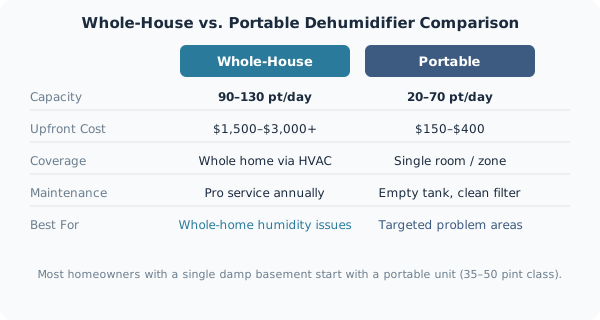
Portable dehumidifiers are standalone units you plug into a wall outlet, position in a specific room or zone, and empty periodically (or drain via gravity hose). They're designed for one space: a basement, crawl space, bedroom, or laundry room. Capacity ranges from 20–70 pints per day.
Whole-house dehumidifiers integrate with your HVAC system, installed in the return air duct or bypass duct, and condition all the air in your home as it circulates through the system. Capacity runs 90–130 pints per day. Installation costs $1,500–$3,000 including equipment and labor, on top of the unit price of $800–$2,000.
When a Portable Unit Is the Right Choice
Most homeowners with a single damp basement, crawl space, or problem room are well-served by a portable unit. It's the right tool when:
The problem is localized. One damp basement. One wet crawl space. One laundry room that gets steamy. A portable handles a defined zone efficiently. Even a 1,500 sq ft basement with significant moisture issues can be addressed with one or two correctly sized portables.
You rent. You can't install permanent HVAC equipment as a renter. A portable you can take with you is the only practical option.
Your HVAC system is otherwise adequate. If your home's humidity in finished living areas stays comfortable during summer but the basement alone is problematic, adding a whole-house system is overkill and won't address the basement more effectively than a dedicated portable would.
Budget matters. A correctly sized 50-pint portable solves a damp 1,200 sq ft basement for $250–$350. A whole-house system solving the same problem costs 6–10 times more.
Sizing a portable starts with square footage, moisture level, room type, and climate. Use our dehumidifier size calculator to get the specific pint rating you need, wrong sizing is the most common mistake homeowners make with portable units.
When to Consider a Whole-House System
Whole-house dehumidifiers make sense in specific situations where portables are genuinely inadequate:
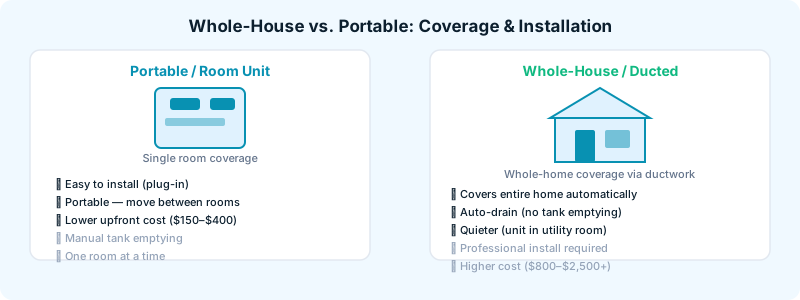
High humidity throughout the whole home. If you're in a very humid climate (Florida, Gulf Coast, much of the South) and your living areas, not just the basement, struggle to stay below 60% RH during summer, a whole-house system addresses the problem at the source. You'd need 3–5 portable units to cover the same ground, and they'd all need individual drains and monitoring.
You have a finished basement or living space below grade. Finished basements with carpeting, drywall, and furniture need consistent humidity control that a single portable positioned in one part of the space may not deliver uniformly. A whole-house system with HVAC extending to the basement handles this more reliably.
Your HVAC system already has capacity. A whole-house dehumidifier installed in the return duct works more efficiently when the existing ductwork distributes the conditioned air throughout the home. Homes with good duct distribution are ideal candidates.
You're building or doing a major renovation. The easiest and cheapest time to install whole-house dehumidification is during new construction or a major gut renovation, when ductwork is accessible.
You want set-it-and-forget-it operation. Whole-house systems have larger reservoir capacity (they typically drain directly to plumbing) and require minimal day-to-day attention. For homeowners who travel frequently, a portable that needs its tank emptied every 12–18 hours is a liability.
The Hybrid Approach: Most Common in Practice
Most homeowners in humid climates end up with a hybrid: whole-home AC handles above-grade humidity reasonably well during the cooling season, plus one or two portables dedicated to the basement and crawl space year-round.
This is more practical and cost-effective than a whole-house dehumidifier for the majority of homes because:
- The basement and crawl space have persistent year-round moisture from the soil that requires dedicated treatment
- Above-grade living areas are usually manageable with AC during summer
- In fall and winter, above-grade humidity is often low enough that nothing is needed
The right portable for most basement applications is a 35–50 pint ENERGY STAR unit with a built-in pump or gravity drain, you don't want to manually empty a tank in a cold basement every day. Our dehumidifier sizing guide for basements covers capacity selection in detail.
Sizing a Portable: Quick Reference
For a portable unit serving a typical basement:
- Under 500 sq ft, slightly damp: 20-pint unit
- 500–800 sq ft, moderately damp: 30-pint unit
- 800–1,200 sq ft, moderately damp: 35-pint unit
- 1,200–1,800 sq ft, very damp or humid climate: 50-pint unit
- 1,800–2,500 sq ft, any condition: 50–70 pint unit, or two 35-pint units
Our room dehumidifier calculator handles the math precisely, accounting for your moisture level and climate zone.
Whole-House System Costs vs. Portables Over Time
Let's say you have a 1,500 sq ft basement with moderate dampness in a humid climate. You need roughly 50 pints/day of capacity.
Option A, Portable route:
- Equipment: $350 (one 50-pint ENERGY STAR unit)
- Annual operating cost: ~$138/year (humid climate estimate)
- 10-year total: ~$1,730
Option B, Whole-house system:
- Equipment + installation: $2,500–$4,000
- Annual operating cost: ~$180/year (larger unit, slightly more efficient per pint)
- 10-year total: ~$4,300–$5,800
For a single damp basement, the portable wins on cost by a wide margin. The whole-house system's advantages, coverage, convenience, reliability, are real but may not justify the premium for most homeowners with a localized problem.
For questions about what's realistic for your specific home, read our overview on what drives annual dehumidifier energy costs and our complete basement dehumidifier sizing guide.